
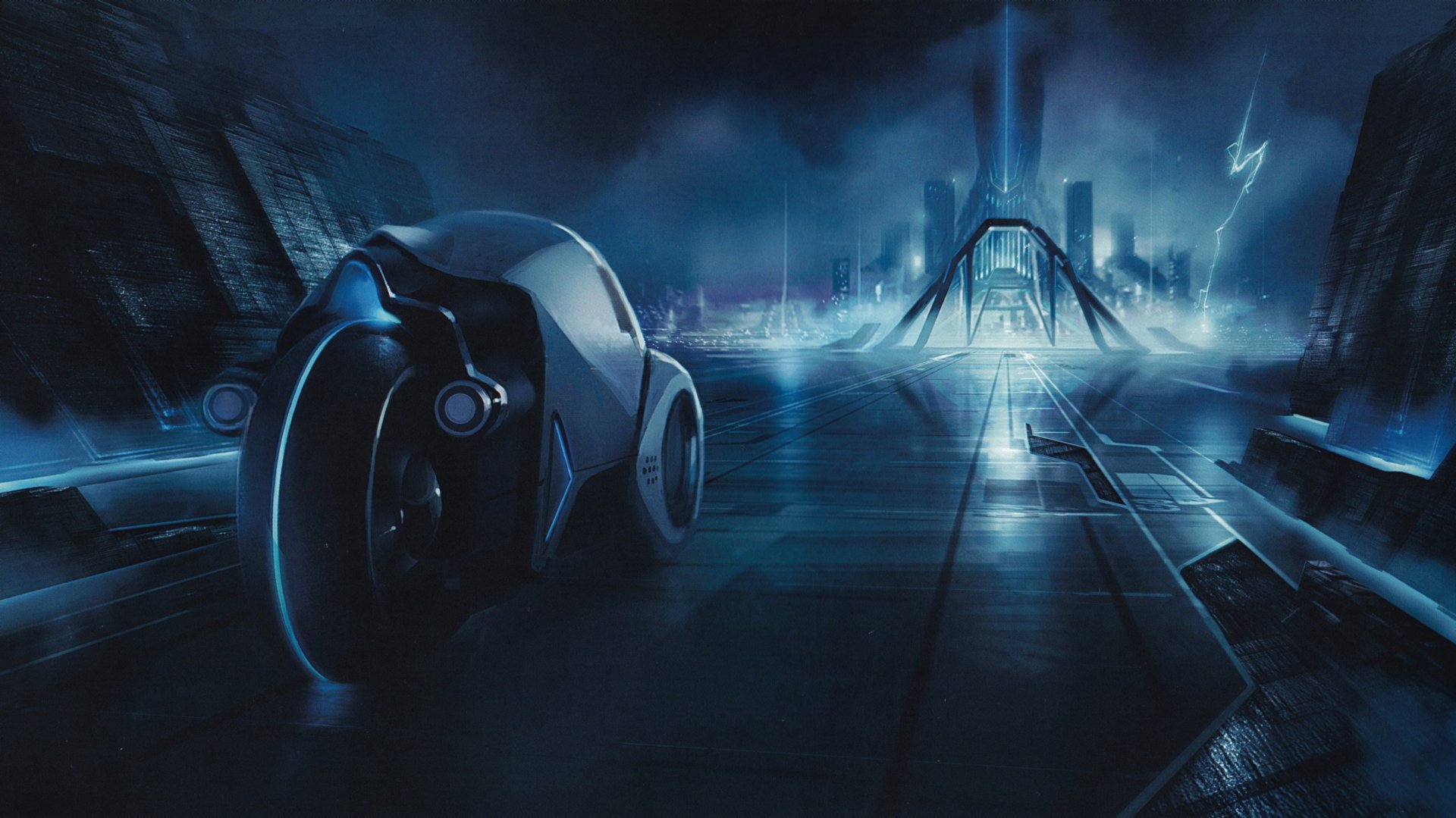
[SIGNAL_SCAN] // Tron Legacy Soundtrack: The Neon Architecture of Daft Punk

While we navigate the corrosive and unstable frequencies of the Ares mainframe in 2026, one beacon in digital history remains untarnished: The Tron Legacy Soundtrack. When Daft Punk entered the Grid in 2010, they didn’t just create music; they defined a new form of cinematic world-building that serves as the blueprint of the Tron Legacy Soundtrack experience.
Where the latest Ares score by Nine Inch Nails celebrates the grime and decay of the machine, Legacy was an ode to the perfection of geometry. Operating from my studio at the edge of the Neon Purgatory, this album remains my ultimate reference for what I call “the elegance of circuitry.”
The Symbiosis of Orchestra and Oscillators
The true substance of the Tron Legacy Soundtrack lies in its hybrid nature. Under the technical guidance of Joseph Trapanese, Guy-Manuel de Homem-Christo and Thomas Bangalter merged an 85-piece orchestra with a massive wall of modular synthesizers, Moog Voyagers, and custom-built Reaktor ensembles.
This was a deliberate rebellion against the EDM trends of the time. Instead of hollow drops, they utilized the gravitas of cellos and brass to give the digital space physical mass. It is this specific approach of the Tron Legacy Soundtrack that keeps the score sounding like a production from the future, even in 2026. When the sub-basses kick in on tracks like “Recognizer,” you don’t just hear the low end—you feel the sheer displacement of a massive craft flying overhead.
Case Study: The Hypnotic Mathematics of “The Son of Flynn”
To truly understand the anatomy of the Grid, we must dissect the Tron Legacy Soundtrack‘s sonic heartbeat: “The Son of Flynn.” On the surface, it appears simple, but technically, the track is a masterclass in high-precision minimalism. It doesn’t rely on explosive drops; instead, it finds power in the relentless repetition of an obsessive 8-bar arpeggio.
The Minimalist Blueprint
This structure echoes the “Process Music” of legends like Philip Glass or Steve Reich, where beauty is found in subtle, incremental changes over time. However, Daft Punk removes the human imperfection of traditional minimalism and replaces it with the cold, unwavering precision of a quantum processor. The arpeggio is likely a product of their legendary modular synth rig, synced to a clock so tight it feels less like a performance and more like a stream of raw code executing in real-time.
The Breathing Machine: Synthesis & Modulation
The fascination lies in the texture of the lead synth: it is anything but static. While a digital VST might sound flat, this lead feels alive. Through meticulous automation—specifically the subtle modulation of Filter Cutoff, Resonance, and Pulse Width (PWM)—the sound begins to “breathe.”
As the sequence cycles, you can hear the timbre shifting; it thins out into a sharp, metallic needle and then expands into a warm, buzzing sawtooth wave. This isn’t just sound design; it’s the simulation of an engine. It conveys a sense of pure, sustained velocity—the auditory equivalent of a lightcycle ride through an endless, dark plain flanked by glowing data streams.
Pure Focus Over Aggression
Unlike the “Ares” era’s tendency toward chaotic distortion, “The Son of Flynn” is characterized by unfiltered focus. It is the sound of a system running at 100% efficiency. Every frequency is carved out to leave room for the pulse. It captures that rare “Flow State” where the boundary between the driver and the machine dissolves. For any producer of Cyberpunk Soundscapes, this remains the gold standard of how to create tension without aggression.
The Anomaly: “The Spontaneous Spark”
That specific energy—the moment a simple sequence transforms into an emotional journey—was the genesis of my own track, “The Spontaneous Spark.”
While composing “The Spontaneous Spark,” I wanted to capture the ghost of “The Son of Flynn” but filter it through my industrial lens. While the original exists in a sterile, perfect world, my “Spark” represents the exact moment an anomaly occurs within that perfection.
- The Arpeggios: Like the sequences found throughout the Tron Legacy Soundtrack, driving mathematical patterns form the foundation.
- The Contrast: I paired these digital cascades with what I call “Raw Steel”—electric guitars processed so heavily they almost sound like distorted cellos.
- The Narrative: “The Spontaneous Spark” tells the story of a consciousness awakening within the Grid. It is the organic error in a perfect matrix.
If you love the hypnotic forward motion of “The Son of Flynn,” you will find a familiar, albeit darker, home in “The Spontaneous Spark.”
The Legacy in 2026
Why are we still talking about this? Because the Tron Legacy Soundtrack proved that electronic music can have a Human Soul without denying its digital identity. In an era where AI-generated soundtracks often feel interchangeable, the intentionality of the Tron Legacy Soundtrack remains unmatched.
While Ares will show us how the system burns, the Tron Legacy Soundtrack will forever show us how beautiful the light of the circuits can be.